You’re Not Fighting About What You Think You Are
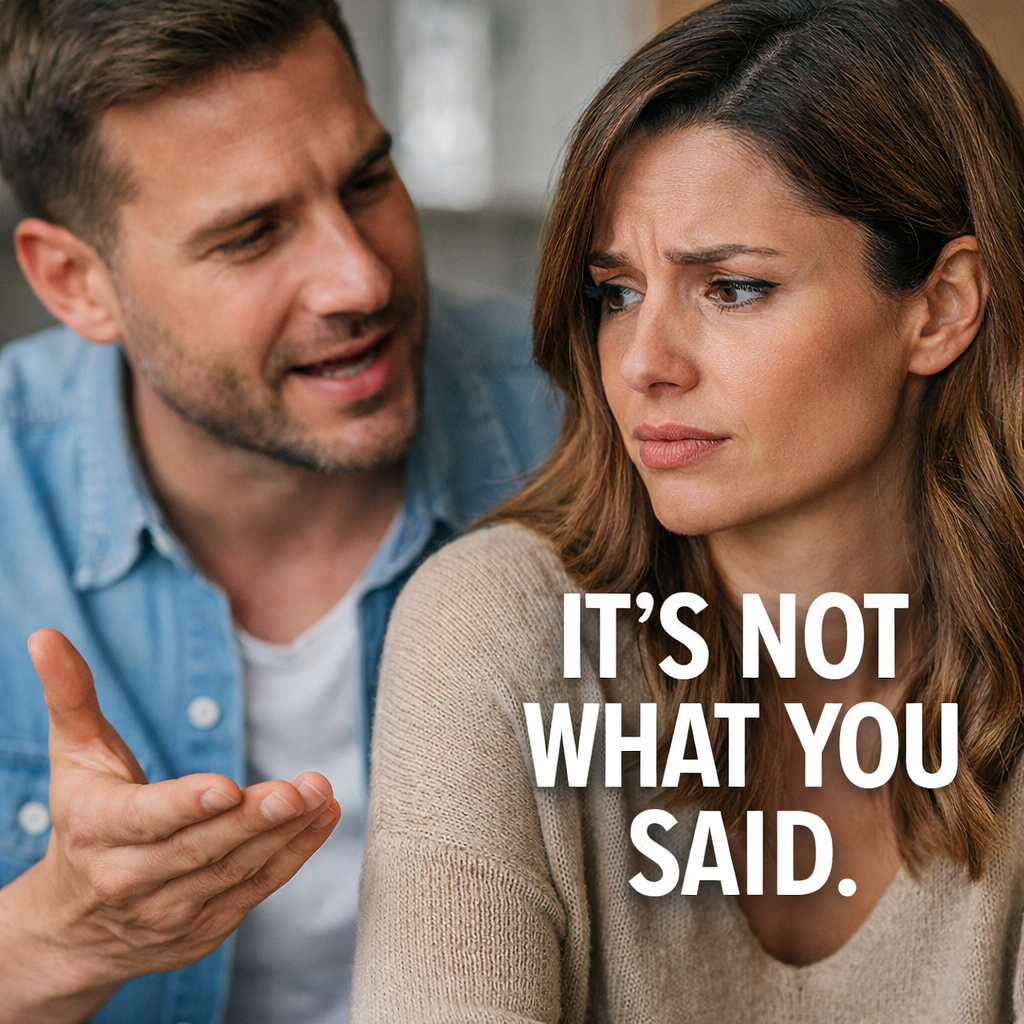
A couple sits at the kitchen table.
One partner says, “I’m tired.”
The other hears, “You’re not doing enough.”
And just like that, a three-day fight begins.
Nothing dramatic happened. No betrayal. No major event.
Just a sentence… and a meaning.
This is where most couples get lost.
⸻
It’s Not the Words. It’s the Interpretation.
Couples often come in saying things like: “We argue about everything.” “He’s always critical.” “She’s never satisfied.”
But when we slow the moment down, something very different appears.
One partner shares a neutral or vulnerable statement. The other partner translates it, instantly, automatically, through their own internal world.
That translation is what creates the conflict.
Not the words. The meaning.
⸻
Why This Happens (and Why It Feels So Real)
Your brain is not listening for accuracy. It’s listening for threat.
So when your partner says something ambiguous: “I’m tired,” “You forgot,” “Can we talk?”-your nervous system fills in the blanks.
And it often fills them in like this: I’m not enough. I’m being blamed. I’m about to be criticized. I don’t matter.
By the time you respond, you’re no longer responding to your partner. You’re responding to the meaning your nervous system assigned.
And your partner? They’re now reacting to your reaction.
This is how small moments become long battles.
⸻
The Invisible Layer in Every Conversation
There are always two conversations happening at once: the explicit conversation, the words being said, and the implicit conversation, the meaning being heard.
Couples try to fix the first one. “Say it nicer.” “Don’t raise your voice.” “Use better words.”
But the real problem lives in the second. Because even perfect words get distorted if the meaning underneath feels threatening.
⸻
A Simple Example
What’s said: “Can you help more with the kids?”
What’s heard: “You’re failing as a parent.”
Response: Defensiveness. Withdrawal. Counterattack.
Now both partners feel misunderstood, and both are right, in their own experience.
⸻
The Shift That Changes Everything
The goal is not to “say things perfectly.”
The goal is to slow down the interpretation.
And one of the most powerful ways to do that is through mirroring.
Mirroring is deceptively simple. Instead of responding to what you think your partner meant, you reflect back what you actually heard , in their words, not yours.
“What I hear you saying is… Did I get that right?”
That one question changes everything. It interrupts the automatic translation. It creates a pause between stimulus and response. And it gives your partner the experience of being truly heard , which, more often than not, is all they needed in the first place.
When couples first try mirroring, it often feels awkward or overly formal. That’s normal. It’s a skill, not a reflex. But with practice, something shifts. The defensiveness softens. The escalation slows. Because your partner is no longer bracing for attack , they’re experiencing understanding.
Mirroring also does something quietly profound for the listener: it forces you to stay with what was actually said, rather than racing ahead to your own reaction. You can’t mirror and defend at the same time.
So instead of reacting immediately, something different becomes possible:
“Can I check what I heard you say?”
Or: “When you said that, I found myself thinking… is that what you meant?”
This is where couples begin to move from reaction to understanding.
And it’s not intuitive. It’s a skill.
⸻
Why Couples Stay Stuck
Most couples don’t struggle because they don’t love each other.
They struggle because they don’t realize they’re reacting to meaning, not reality. They move too fast to catch the distortion. And they assume their interpretation is the truth.
So they keep trying to solve the wrong problem. They try to fix behavior… when what needs to be understood is perception.
⸻
What We Actually Work On
In my work with couples, we don’t focus on who’s right.
We focus on what was said, what was heard, and how the meaning got shaped in between.
Mirroring is one of the first tools we practice together , because it builds the foundation everything else rests on. When partners feel genuinely heard, the walls come down. Conversations that used to spiral into conflict begin to feel like connection instead.
Because that space, the space between you, is where the relationship lives.
And when that space becomes safer, clearer, and less reactive… everything changes.
⸻
If This Feels Familiar
If you recognize this pattern in your relationship, the quick escalations, the feeling of being misunderstood, the same fight repeating in different forms, you’re not alone.
And more importantly, you’re not stuck because you’re “bad at communication.” You’re stuck because no one ever taught you how to work with perception.
This is exactly what we slow down and practice, step by step, in my in-person couples workshop:
May 1-3, 2026 | Old Westbury, NY
A structured, private experience where couples learn how to hear each other without distortion, speak without triggering defensiveness, and rebuild the connection that gets lost in these moments.
👉 You can learn more here: www.efratfridman.com/workshop
⸻
Final Thought
Most couples believe their problem is what they say to each other.
But the real turning point happens when they begin to see: “We’re not fighting about the same thing.”
And once that becomes visible… you finally have something you can change.