Why Couples Fight More on Vacation(And What It Reveals About Your Relationship)
You spend months planning the perfect vacation.
You research hotels, save restaurant recommendations, and build an itinerary you'll remember for years. You imagine reconnecting, laughing over dinner, finally slowing down together after months of work and parenting.
Then, somewhere between the airport, the rental car, and deciding where to have lunch, you're arguing.
About the museum.
The GPS.
The hotel.
The budget.
It feels ridiculous. You may even find yourself thinking, We never fight like this at home.
But here's what I've learned after more than twenty years of working with couples:
Vacations rarely create relationship problems. They reveal the patterns that already exist.
Some of the biggest breakthroughs I've witnessed in couples therapy began with a vacation that didn't go according to plan.
The argument usually isn't about the museum
Last summer, a couple I'll call Dan and Maria returned from what should have been a dream trip to Italy. Instead, they spent nearly three days in silence after arguing about which museum to visit in Florence.
“It ruined the whole vacation,” Maria told me.
Except it wasn't really about the museum. It was about two people trying to feel emotionally safe in very different ways.
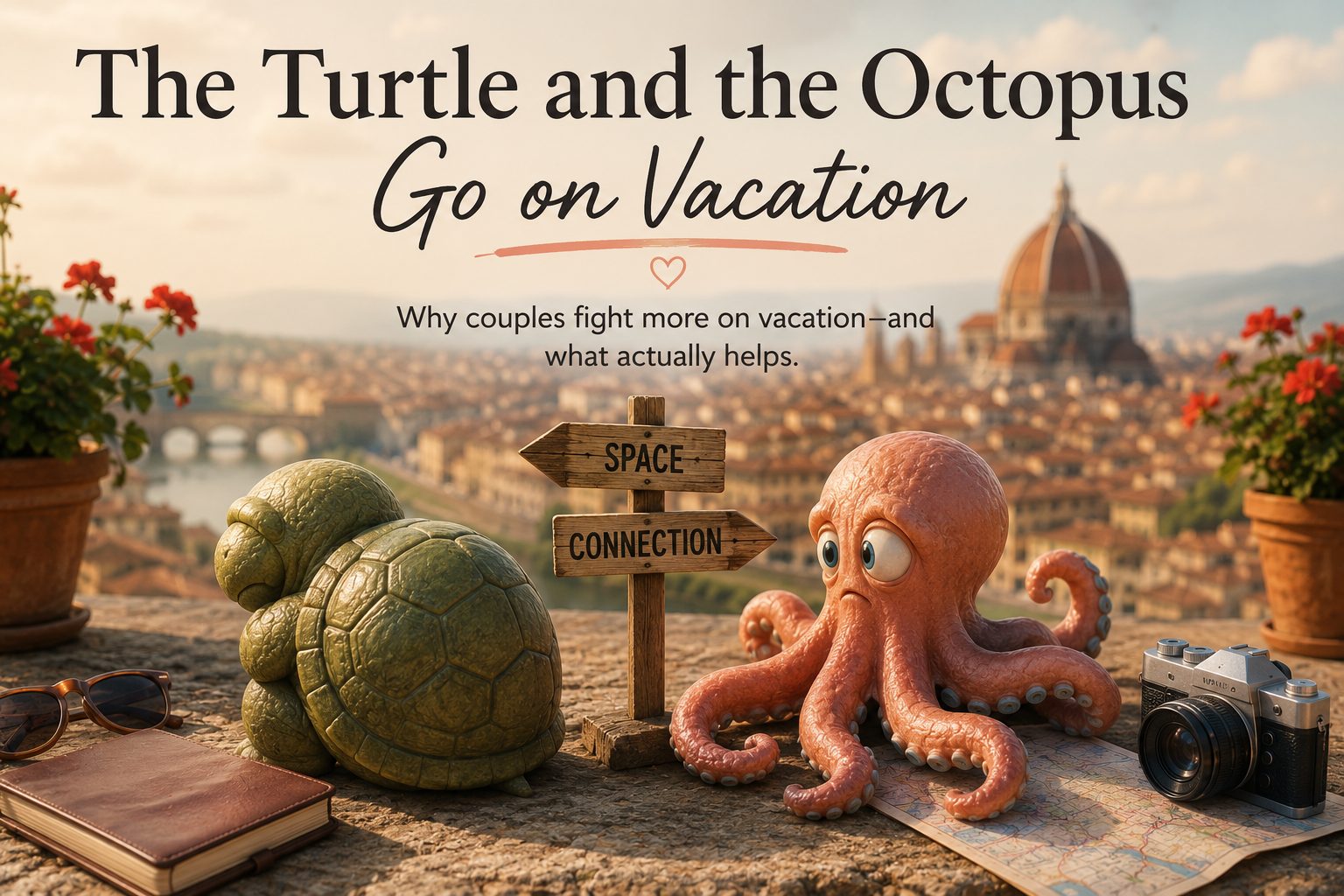
Meet the Turtle and the Octopus
Over the years, I've found that many couples recognize themselves in two patterns I call the Turtle and the Octopus.
When stress rises, the Turtle instinctively moves inward. They get quiet. They need space. They process emotions privately before they're ready to reconnect.
The Octopus does the opposite. When something feels wrong, they move toward connection — they want to talk, solve the problem, feel close again.
Neither response is healthier. Neither is a character flaw. They're attachment strategies — automatic ways our nervous system learned to protect us, often long before we met our partner. Under pressure, the nervous system reaches for whatever once helped it feel safe.
The trouble is, Turtles and Octopuses often fall in love with each other. One seeks space. The other seeks closeness. Without understanding the pattern, each misreads the other's intentions.
The Turtle thinks: “Why won't you give me a little room to breathe?”
The Octopus thinks: “Why are you pushing me away?”
Both feel hurt. Both feel misunderstood. Neither realizes they're chasing the same thing: emotional safety.
Why vacations turn up the volume
Travel strips away the routines that normally help us regulate ourselves. You're sleeping differently, eating differently, navigating unfamiliar places — and spending far more time together than usual. Add high expectations and the money you've invested, and even a wonderful trip puts real stress on the nervous system. Stress makes attachment patterns louder.
Dan is an Octopus. After a long day walking through Florence, he noticed Maria growing quiet. Feeling disconnected, he did what came naturally — planned another museum, another café, another chance to reconnect.
Maria is a Turtle. The more overwhelmed she felt, the more she needed stillness — a coffee, some quiet, a moment to simply breathe.
Dan experienced her silence as rejection. Maria experienced his pursuit as pressure. Neither was trying to hurt the other. Both were trying to feel safe.
This is why couples so often find themselves having the same argument in different places, over different things — an itinerary, a budget, a photo, a restaurant choice. The content changes. The pattern underneath rarely does.
How to interrupt the cycle
You don't have to eliminate your differences. You just need to recognize them sooner — and remember that what you're managing isn't a bad habit, it's a nervous system doing what it learned to do long ago.
If you're the Turtle: name your need before you disappear. “I need twenty minutes to recharge — it's not about you.” Then come back when you said you would. Reliability is what makes space feel safe instead of like distance.
If you're the Octopus: say the need directly instead of increasing the pressure. “I'm feeling disconnected — can we spend some time together once you've had a chance to rest?” Then actually let your partner have that space, and use it yourself — take a walk, read, journal. The less pressure your partner feels, the sooner they'll move toward you on their own.
The Turtle learns to offer a little more closeness. The Octopus learns to tolerate a little more space. Neither becomes the other. That's where the connection grows — not in sameness, but in the stretch each partner makes toward the other.
The real gift of travel
Dan and Maria returned to Italy the following spring. The museums hadn't changed. The streets of Florence hadn't changed. What changed was their awareness.
Maria recognized when she was becoming overwhelmed and said so before shutting down. Dan noticed his urge to fill every hour with activity — and talked about it instead of acting on it.
Their arguments got shorter. Their repairs got faster. The vacation finally became what they'd hoped for , not because they stopped having differences, but because they finally understood them.
The happiest couples aren't the ones who never argue. They're the ones who catch the pattern early and repair quickly.
So the next time you're arguing about a museum, a map, or where to eat dinner, pause before you assume you picked the wrong destination ,or the wrong partner. Ask instead: What do we each need right now to feel safe?
Sometimes the best souvenir isn't something you bought. It's understanding your partner a little better than when you left.
Ready to strengthen your relationship?
If you recognized yourselves in the Turtle and the Octopus, you're not alone , and this pattern can change.
In my Getting the Love You Want couples workshop , a two-day, in-person intensive on October 17–18 ,
I work with just eight couples at a time so we can go deep on exactly this: recognizing your cycle, repairing quickly, and rebuilding the emotional safety that lets a relationship thrive.
Spots are limited to eight couples. If this is the year you want to stop having the same argument in a new location, I'd love to see you there.